
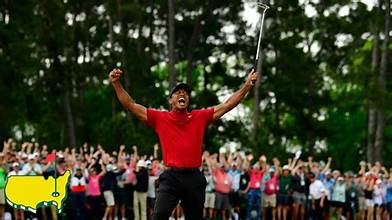
With fifteen major championships, three short of the record set by Jack Nicklaus. Eighty-two PGA Tour victories, level with the legendary Sam Snead. And a great achievement immortalized as the “Tiger Slam,” when he held all four major titles simultaneously.
By any strict standard of evaluation—statistical explosion, competitive strength, and cultural influence, Tiger Woods carries royal air in the hierarchy of golf as a sport, his case as the greatest golfer of all time both understandable and enduring.
Woods’ ascent was not merely historic—it was gigantic. His victory at the Masters in 1997, where he captured his first green jacket by a record margin, signaled a seismic shift in professional golf. He brought with him an amalgamation of power, precision, and psychological edge that reset competitive expectations.
That evolution reached its climax at the U.S. Open at Pebble Beach in 2000, where his 15-stroke victory remains one of the most dominant performances in major championship history. In that moment, Woods was not simply outperforming his competitors—he was the epitome of excellence.
Yet Woods’ story is as much about weakness as it is about supremacy. His career trajectory, once complete and seemingly limitless, became muddled by personal problems and physical deterioration.
Off-course controversies stained his carefully constructed image, while a succession of injuries—culminating in multiple surgeries and a devastating car accident that threatened the usefulness of his right leg—reshaped the projection of his professional life. These problems did more than sideline a champion; they reshaped the conditions under which greatness could be maintained.
The physiological toll has been deep. Repeated surgical operations, chronic pain, and the consequences of aging have imposed limitations on a body once the envy of his peers.
Consequently, Woods’ later career has been defined not by sustained superiority, but by sporadic victories, each victory viewed with both analytical doubts and anticipation steeped with emotions. His improbable victory at the 2019 Masters, for instance, served as a reminder that the competitive nature of his game, though diminished, is not easily overcome.
Now at 50 years of age, Woods exists in a dilemma between legacy preservation and competitive ambition. The statistical probability of increasing his major tally—or even securing another PGA Tour title—has narrowed significantly under the weight of time and heavy expectations. And yet, to reduce Tiger Woods to probabilities is to misunderstand the substance of his game. He has consistently defied standard projections, redefining not only what is achievable, but when and how it may be achieved.
In the final analysis, the enigma of Tiger Woods lies in this grip between inevitability and defiance. His story is not a swift march toward records, but a complex interplay of dominance, decline, and resurgence.
And perhaps that is why, even now, the possibility, however remote—of one more moment of brilliance continues to mesmerize the sporting world.