
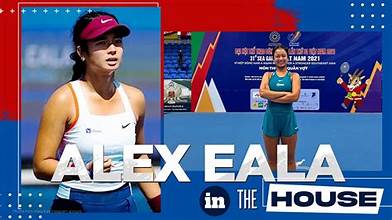
The rise of Alex Eala has been one of the most Cinderella stories in modern tennis—a surge in the WTA rankings feed by undeniable talent, flexibility, and a nation’s unwavering hope in her greatness. From a promising junior player to a legitimate force on the world stage, Eala has climbed as high as World No. 29, an achievement that signaled her arrival among the sport’s elite.
Her subsequent demotion to No. 45, following the expiration of her Miami Open ranking points, is less a setback than a reminder of the unforgiving nature of professional tennis.
What separates Eala from many rising stars is her cool demeanor. She doesn’t just compete—she challenges. Wins over top ten opponents like Iga Świątek, Coco Gauff, Jasmine Paolini, and Madison Keys have supported her reputation as a giant killer. A 5’9” left-hander with a natural feel for the game, she excels on heavy baseline exchanges, great court coverage, and a tactical maturity beyond her years. Add to that the boisterous backing of Filipino fans across the globe, and Eala steps onto every court with both skill and audience support on her side.
Yet even the most meteoric rises encounter stiff resistance—and for Eala, that resistance has come with a familiar nationality.
Czech players have emerged as her most persistent hindrance to success.
Since turning professional, Eala remains winless against players from the Czech Republic, earning a 0–12 record against them that underscores an uncharacteristic defect and psychological block. Her latest defeat came at the 2026 Miami Open, where Karolína Muchová delivered a clinical 6–0, 6–2 humiliation in the Round of 16. Prior losses to Linda Nosková at the 2026 Indian Wells Open and Tereza Valentová at the 2026 Qatar Open—both in decisive fashion—have only deepened the conversation.
This is no mere coincidence. Czech tennis is considered as one of the sport’s known powerhouses, built on a foundation of strict development systems, elite coaching, and a culture that consistently produces world-class tennis players like Ivan Lendl. Their players are known for power serves, aggressive baseline play, and a tactical discipline that punishes hesitation—qualities that have repeatedly disrupted Eala’s gameplans.
The challenge now is not whether Eala can compete at the highest level—she has already proven that she can. The question is whether she can adapt.
Breaking through this “Czech barrier” will require more than adjustments; it will demand sacrifice and guts. Sharper returns against big servers, greater variation to offset baseline predictability, and the ability to dictate tempo against physically imposing players could be key. Her team must turn patterns into opportunities—study tendencies, exploit weaknesses, and make strategies that tilt the balance in her favor.
Because in the journey to greatness, every champion faces a defining limitation—a rivalry, a surface, a style that tests the limits of their game.
For Alex Eala, that test wears Czech colors.
And if history has taught us anything, it is that the players who dare to solve their toughest tests are the ones who ultimately redefine their legacy.